PatchPatrol

AI code review for GitLab that doesn't suck and won't disappear into a black-box abyss

Stop wondering whether your merge requests got meaningful review signal. Run bounded reviews, publish inspectable artifacts, and skip the mystery.

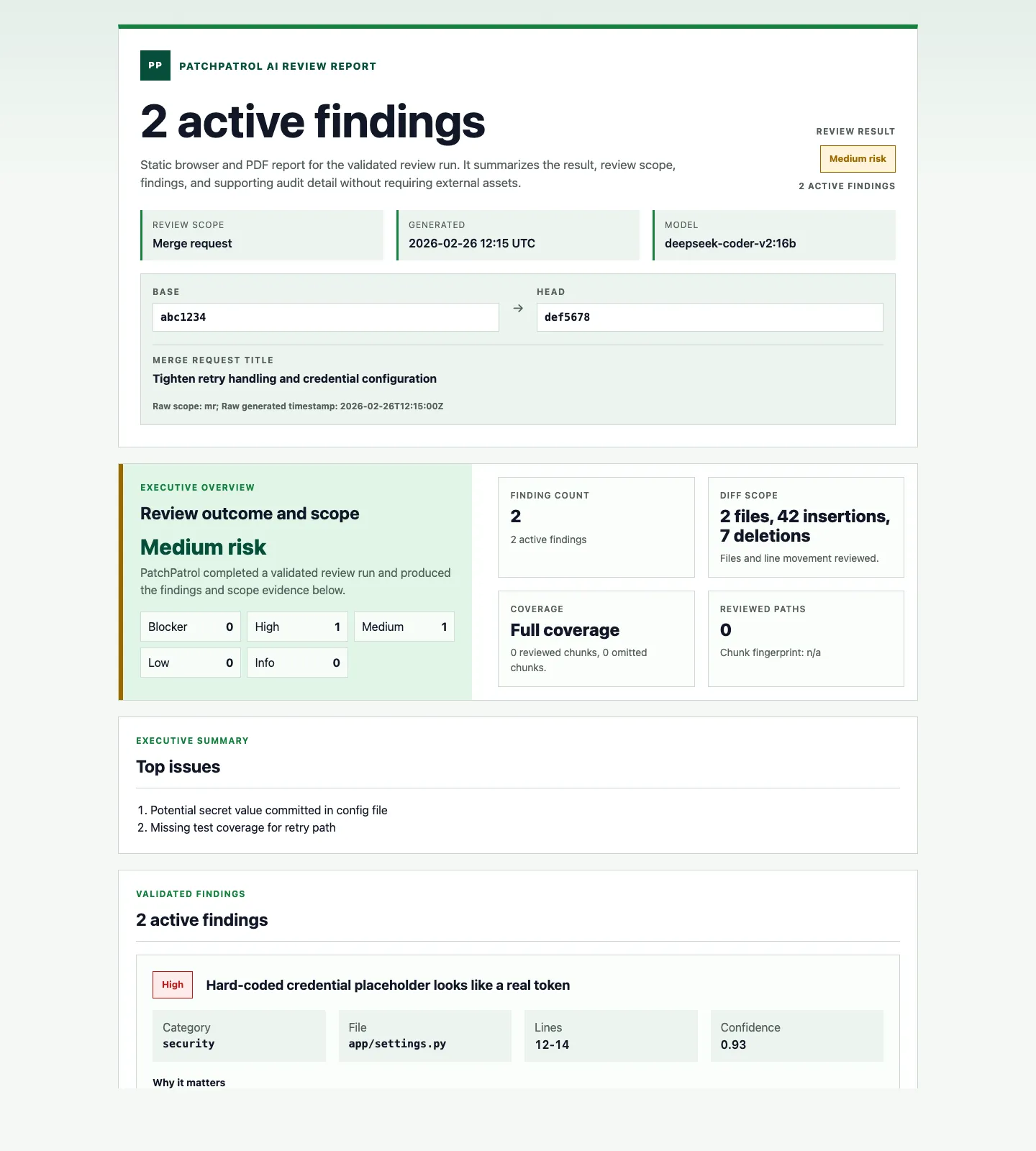
Temporary PatchPatrol homepage preview screenshot

Product proof

PatchPatrol gives teams one review path they can explain, inspect, and control.

Review scope stays bounded

PatchPatrol starts from explicit GitLab or local diff context, then keeps the review path tied to the change instead of wandering across the repository.

Artifacts stay inspectable

Each run produces `ai-review.md` and `ai-review.json` so teams can read the summary quickly and still keep a structured contract for downstream automation.

Trust posture stays explicit

The product is built for self-hosted GitLab CI, local developer workflows, and customer-controlled model endpoints where privacy boundaries matter.

Why teams use PatchPatrol

The value is not more AI surface area. It is a safer, clearer first review signal.

PatchPatrol is for teams that already review code seriously and want faster signal without giving up accountability, privacy posture, or control over where model calls go.

Give reviewers a faster first pass

Teams use PatchPatrol when they want earlier signal on GitLab merge requests without turning review into a black-box automation step.

Keep human judgement in the loop

The output is meant to support reviewer decisions, not replace them. PatchPatrol helps teams preserve human judgement while making review runs more repeatable.

Stay privacy-first by default

PatchPatrol favors customer-controlled model endpoints, bounded context collection, and artifact-first delivery over vague claims about autonomous AI.

How the first review path works

The first PatchPatrol rollout stays focused: bounded input, explicit trust checks, then artifact-first output.

Step 01

Start from the review context that matters

PatchPatrol resolves GitLab merge requests or local developer diffs so the run begins from the exact change a team wants reviewed.

Step 02

Constrain the run before provider calls

The review scope is chunked into bounded work and checked against trust gates before anything is sent to a model endpoint.

Step 03

Publish evidence teams can inspect

The first rollout path stays artifact-first: reviewers inspect `ai-review.md`, keep `ai-review.json` for structured follow-on use, and decide what action to take next.

Start with docs when you need the technical path

The website explains fit first. The docs surface takes you through the actual setup and follow-through path.

PatchPatrol keeps technical onboarding in the separate `/docs` surface so visitors can choose the role-specific path they need without turning the launch site into a reference index.

Admin path

Set up the first supported review flow

Use the admin quickstart when you need the GitLab artifact-first setup path, provider prerequisites, and the first rollout contract.

Open admin quickstart

Developer path

Follow the first review as a developer

Use the developer quickstart when the workflow is already wired and you need to understand the first run, artifacts, and next shared steps.

Open developer quickstart

Direct help

Use contact when fit or rollout shape is the real question

If the next step is deciding whether PatchPatrol fits your environment or constraints, stay on the direct conversation path instead of jumping straight into setup docs.

Talk to PatchPatrol